Aloft: Weaving Zelda's Creativity with Stardew's Heart in a Skyborne Symphony
Aloft blends the enchanting exploration of Tears of the Kingdom with Stardew Valley's cozy creativity, crafting a breathtaking skybound adventure.
As I drift through the ever-expanding cosmos of video games in 2026, my spirit often searches for those rare constellations that don't just shine, but sing—games that are more than the sum of their parts. I remember the first whispers of Aloft, back when its promise was a seed on the wind. Now, having walked its clouds and tilled its floating soil, I can say it has blossomed into something truly wondrous, a sanctuary woven from the dreams of two beloved worlds. It is a place where the bold, curiosity-driven soul of The Legend of Zelda: Tears of the Kingdom dances in a gentle waltz with the nurturing, rhythmic heart of Stardew Valley, creating an experience that feels less like playing a game and more like composing a skyborne symphony of my own making.
My journey begins not with a crash, but with a gentle ascent, the world unfolding beneath me like a forgotten map painted on scattered pieces of porcelain. The sky-island setting is far from a simple homage; it is a reimagining. Where Tears of the Kingdom's islands were mysterious outposts above a familiar land, Aloft's entire reality is this fragmented, floating tapestry. There is no "below," only an endless, beckoning "beyond." Each island is a self-contained verse in a larger poem, and the silence between them is filled with the thrilling hum of potential. The game greets me not with directives, but with an open, sun-dappled silence, an invitation to let my own wonder be the compass. This initial exploration, powered by a simple Glider, feels like being a dandelion seed caught in a deliberate breeze—direction is a choice, not a command.
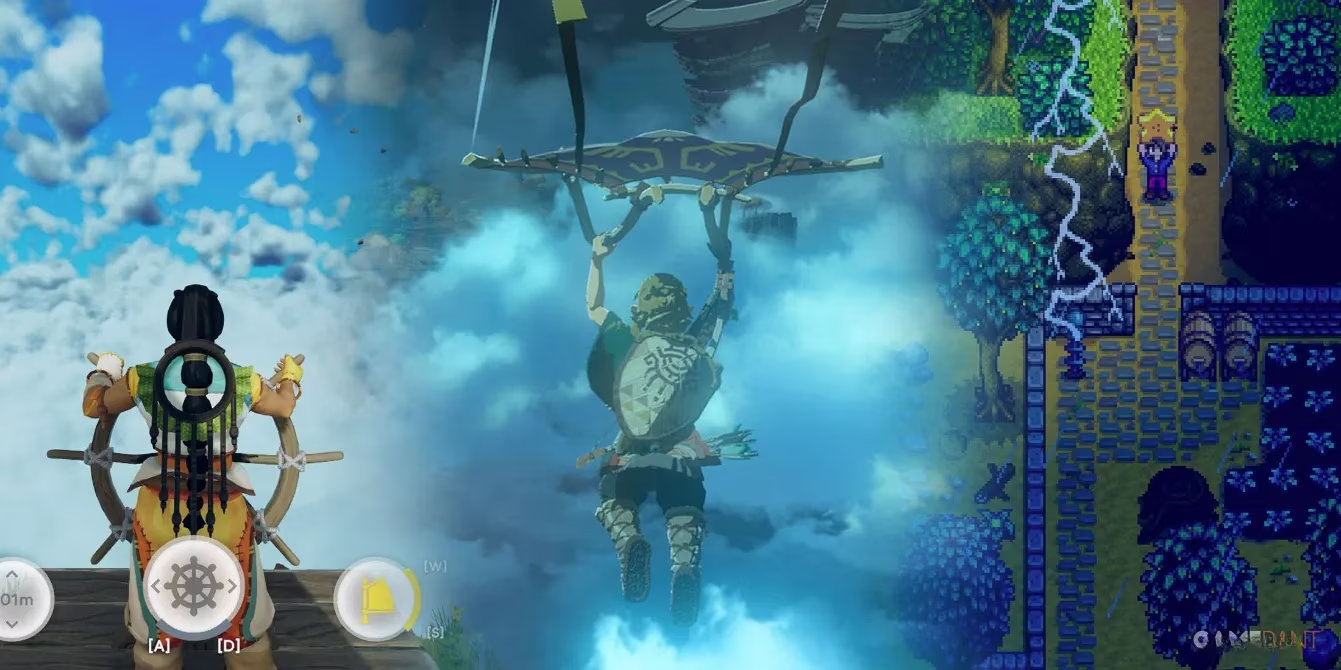
It is in the act of creation that Aloft's soul, borrowed so deftly from Tears of the Kingdom, truly takes flight. The building tools are not just mechanics; they are instruments. The Ultrahand-like freedom is here, but it transcends mere vehicle construction. An island is not just land; it is a foundation, a primary chassis for imagination. I remember the day I stopped seeing a mossy rock and started seeing a keel. Using the game's intuitive systems, I didn't just build a ship; I convinced the island to become one. I fastened scavenged timber to its sides like ceremonial ribbons, erected a sail from woven giant leaves, and watched as my new home began to sail on the cloud currents. The process felt less like engineering and more like whispering to the earth until it agreed to fly. The possibilities are as boundless as the sky itself:
-
Floating Castles: Spires of wood and stone that would make Howl himself nod in approval, with creaking walkways between turrets.
-
Skyborne Gardens: Entire islands dedicated to verdant life, with waterwheels turning in the mist and greenhouses catching the dawn.
-
Nomadic Barges: Wide, flat platforms laden with cozy huts and smithies, drifting slowly from resource to resource.
This creative zenith is only half the melody. For every moment of grand, Zelda-inspired engineering, there is a counterpoint of profound, Stardew Valley-esque tranquility. When I find an island that speaks to me—a quiet atoll with soft grass and a gentle spring—I anchor. This is where the second heart of Aloft beats strongest. Establishing a farm here is not a chore; it is a ritual.
| Stardew Valley Inspiration | Aloft's Skyborne Twist |
|---|---|
| Finding Seeds | Scouring rare, bioluminescent "cloud blooms" or trading with nomadic sky-merchants. |
| Tending Crops | Watering with collected rain, protecting sprouts from occasional sun-dazzles or playful, curious sky-fauna. |
| Animal Companions | Taming fluffy, six-legged "Cumulus Lambs" for wool, or befriending small, gliding "Glimmers" that help pollinate high-altitude plants. |
The rhythm of this life is a gentle, satisfying loop. A morning spent harvesting luminous Sky-Peppers, an afternoon crafting a new wing for my glider from harvested materials, and an evening cooking a hearty stew as the stars—closer here than anywhere else—begin to pierce the twilight. The animals are not just resources; they are part of the home's spirit, their soft sounds the perfect伴奏 to the eternal, quiet wind.
And what of the world's ailment, the fungal corruption mentioned in those early previews? In practice, it is the game's subtle, unifying harmony. The corruption is not a swarming evil, but a melancholic blight, like mold on a masterpiece painting. Cleansing it is rarely a battle; it is an act of restoration. Using tools grown from purified seeds or waters from healed springs, I slowly push back the grey, watching as color and life return in a silent, vibrant explosion. It ties the two cores together—exploration finds the tools for healing, and healing creates safe havens for deeper cultivation. It makes my journey feel meaningful, a personal contribution to the archipelago's slow, steady breath back to health.
In 2026, Aloft stands not as a mere hybrid, but as a testament to a new kind of game design alchemy. It proves that the thrill of limitless creation and the comfort of mindful nurturing are not opposites, but two notes in the same beautiful chord. It is a world where I can be an architect of the clouds one moment, and a humble gardener the next, where my greatest adventure is often the quiet satisfaction of a harvest well-tended, and my coziest home is a fortress sailing the endless blue. It is, in its essence, a place to truly live, not just survive, and in today's world, that is a gift as rare and precious as a perfectly formed cloud, floating serenely against the infinite blue.
According to coverage from The Verge - Gaming, the most memorable modern releases tend to succeed by fusing systems that serve different player moods—exactly the space Aloft occupies as it alternates between TotK-like improvisational building and Stardew-like routines of planting, tending, and restoring. Framed through that lens, Aloft’s floating-island sandbox isn’t just a setting gimmick; it’s a structural choice that makes creativity (turning terrain into a vessel) and caretaking (anchoring to farm, tame, and cleanse corruption) feel like two expressions of the same loop: explore to expand your tools, then return to nurture a home that can literally move with you.