Beyond the Forked Rivers of Time: The Lonely Stance of Hyrule's Modern Legends
Explore the Zelda timeline and Hyrule Historia, uncovering how Breath of the Wild and Tears of the Kingdom reshape the legend’s chronology.
The tapestry of Hyrule, woven with threads of courage, wisdom, and power, has always been a complex and shifting mosaic. For decades, fans attempted to chart its course, connecting islands of legend across a vast, chronological sea. Then, in 2011, the Hyrule Historia arrived, offering a map—a tripartite timeline born from the pivotal moment in Ocarina of Time. Yet, as the years flowed toward 2026, two monumental epics, Breath of the Wild and Tears of the Kingdom, have steadfastly refused to be pinned to this map. They stand apart, like twin peaks shrouded in a temporal mist, their connection to the established rivers of history deliberately, poetically, ambiguous.
The official timeline, as it stands, remains a tale of three roads diverging in a golden wood:
-
The Downfall Timeline (Hero is Defeated): A path of melancholy resilience, where Link falls in Ocarina of Time. This branch cradles classics like A Link to the Past, Link's Awakening, and the original NES adventures. It's often seen as the old-school lineage, where tradition runs deep.
-
The Child Timeline: A world where the Hero of Time returns to his youth, bearing the burdens of memory. This road leads to the haunting masks of Termina (Majora's Mask) and the twilight-shrouded fields of Twilight Princess. It's a path of personal consequence and shadowed legacies.
-
The Adult Timeline: A universe where Link is gone, leaving a Hyrule eventually drowned by the gods. Here, the winds guide new heroes across the Great Sea in The Wind Waker and the spirit rails of Spirit Tracks. It's a timeline of letting go and forging new beginnings, a whole new ball game for the kingdom.
Into this neatly charted cosmos erupted Breath of the Wild. Its Hyrule was a beautiful, ruinous paradox—simultaneously ancient and innovative, littered with echoes of every era yet belonging to none. The 2024 update to the official timeline graphic, displayed at events and mirrored online, made this separation starkly visual. While the three classic timelines were linked by clear, branching lines, Breath of the Wild and its direct sequel, Tears of the Kingdom, sat in their own box, detached. No connective tissue, just... space.
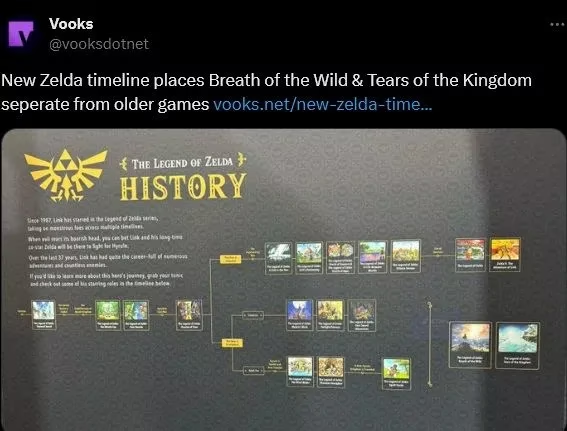
This visual statement is louder than any lore scroll. It tells us that these games operate on a different wavelength. They are not merely the next chapter in a known book; they are perhaps a new volume on a separate shelf, drawing from the entire library for inspiration. The lack of a line between the two sequels themselves is likely just Nintendo being Nintendo—a minor graphical quirk, not a narrative rift. Everyone and their grandma knows Tears follows Breath. But their collective exile from the main timeline? That's the real tea.
So, what does this mean for the lore? Let's break down the prevailing theories swirling among fans in 2026:
| Theory | Proposed Placement | Core Reasoning |
|---|---|---|
| The Convergence Theory 🧬 | At the very end of ALL timelines | Suggests a cataclysmic event merged the three branches, creating the "Calamity" era we see. It's the ultimate fan service, a unification of all histories. |
| The Far-Future Downfall ⏳ | Way after Zelda II in the Downfall Timeline | Posits that the advanced, forgotten tech (Sheikah, Zonai) represents a civilization that rose long after the classic 2D adventures. A diametrically opposed aesthetic, but chronologically possible. |
| The Soft Reboot 🔄 | A new, fourth branch or a fresh start | Argues these games are a narrative reset, keeping the spirit but loosening the canonical shackles. It's not about where they fit, but that they don't need to fit. |
This ambiguity is, in many ways, a feature, not a bug. It allows the developers creative freedom unbound by centuries of convoluted history. Every ancient pillar and forgotten melody in Breath of the Wild and Tears of the Kingdom can be a tantalizing Easter egg rather than a strict continuity lock. The Zonai civilization, with its god-like stature and mysterious disappearance, feels like a legend that could belong to any era, or none at all.
The question of placement now extends to newer entries. The Legend of Zelda: Echoes of Wisdom, with its charming, toy-like aesthetic reminiscent of the Link's Awakening remake, naturally sparks speculation. The smart money places it in the Downfall Timeline, likely nestled between or after games like A Link to the Past and Link's Awakening. Its art style is a nod, not necessarily a narrative handcuff. As of 2026, its official spot on the chart remains a delightful mystery, a reminder that Nintendo holds the timeline with a deliberately loose grip.
Ultimately, the lonely stance of Breath of the Wild and Tears of the Kingdom is their greatest strength. They are myths about the decay and reconstruction of myth itself. They ask: What happens when a legend is so old, its origins crumble into dust? The answer is a Hyrule where every canyon whispers a different version of the past, and the hero's role is not to fulfill a predetermined destiny, but to listen to all the echoes and choose his own path forward. They exist in the sweet spot—respectful of the past but unafraid to gaze at the horizon, proving that sometimes, the most powerful stories are the ones that can't be pinned down.