I Recalculated Hyrule's Gravity in Tears of the Kingdom
Tears of the Kingdom fans calculated Hyrule gravity at ~28.2 m/s²—about 3x Earth’s—by analyzing Link’s falls and pendulum swings.
In 2026, three years after Tears of the Kingdom first dropped me into Hyrule, I still find myself testing the world's rules like a kid poking a sleeping dragon with a stick. I still revisit a post by a player named JukedHimOuttaSocks, who did something I would never have thought to do: they treated Link's falls as raw physics data. I read the breakdown twice, then a third time, because the conclusion was absurdly satisfying: Hyrule's gravity may be roughly three times Earth's.

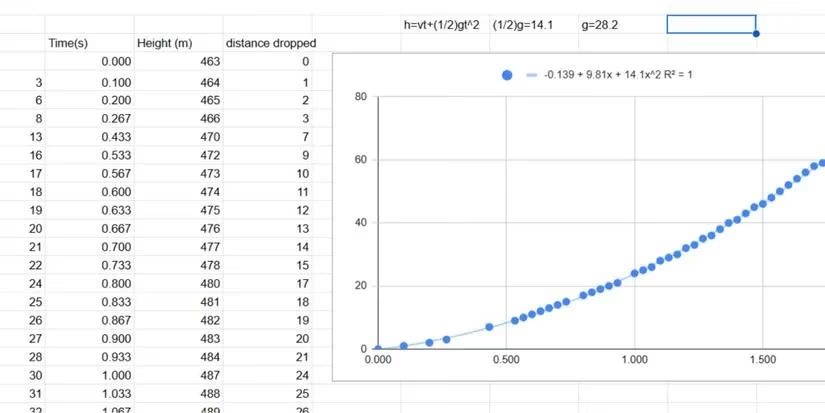
Here is how the experiment unfolded. JukedHimOuttaSocks had Link stand on a platform that could disappear after a short time, then recorded how fast he fell. Over a 60-meter drop, they logged Link's Z-coordinates—his position in 3D space—for every meter of the fall. I imagine the data table looking like a ladder made of numbers, each rung a snapshot of Link plunging toward the ground. When plotted, those points formed a smooth parabolic curve with a quadratic term. The parabola was a fingerprint pressed into the air, and I could almost see the invisible hand that made it. From that curve, the player extracted Link's downward acceleration: approximately 28.2 meters per second squared.
Earth's standard gravity is about 9.81 m/s². Put those numbers side by side and the gap is not subtle. Hyrule's gravity comes out at roughly 2.87 times Earth's, or about three times if we speak in round, dramatic terms. Hyrule's gravity behaves like a silent stagehand: it never takes a bow, yet it yanks every jump and fall with three times the urgency. I had always felt that Link's leaps were strangely heavy and his falls strangely final. Now I had a number for that feeling.
To make sure the result was not a one-off, JukedHimOuttaSocks ran pendulum experiments too. They measured the length and period of each pendulum, timed a full swing, and calculated the expected gravitational acceleration. The pendulum data arrived with the stubborn consistency of a tide that has never once missed its cue. Same answer: 28.2 m/s².
Then came the clever part. The player also considered the hypothesis that Hyrule's unit of distance may not actually be meters. So they placed a 4-unit-long beam next to Link to check. It turned out to be double his height plus 0.5 units. From that, they deduced that Link's height is 1.75 units. If those units are meters, Link is about 5 feet 9 inches tall, which feels entirely plausible for an average human hero with a sword and a worrying habit of jumping off cliffs.
| Measurement | Result |
|---|---|
| Earth gravity | 9.81 m/s² |
| Hyrule gravity from fall test | 28.2 m/s² |
| Ratio | About 2.87x, or roughly 3x |
| Link's height | 1.75 units, about 5'9" if meters |
I understand why real physics teachers praised the work. The method is simple, transparent, and repeatable: drop something, measure the fall, plot the data, check the curve, and then verify with an independent experiment. It is the kind of playground science that makes a fantasy world feel more solid rather than less. The fact that a fan could extract a coherent gravitational constant from a game about floating islands and time travel is a small miracle of curiosity.
For me, the discovery changes the texture of Tears of the Kingdom. Every shield surf, every arrow, every falling rock now feels like part of a larger joke that the game never bothers to explain. Hyrule is not just a map with a story on top. It is a little physics laboratory wearing a hero's tunic.
And that is why I keep coming back in 2026. There are still many secrets in Tears of the Kingdom's Hyrule, waiting for eager explorers to uncover them. I will be one of the players standing on a disappearing platform, notebook in hand, ready to fall again.