The Future of Zelda: Why a Playable Princess Should Blend Tears of the Kingdom's Heroism with Spirit Tracks' Gameplay
The Legend of Zelda franchise is poised for a revolutionary shift, envisioning Princess Zelda as the playable protagonist by merging the epic, legendary narrative of Tears of the Kingdom with the innovative cooperative mechanics of Spirit Tracks.
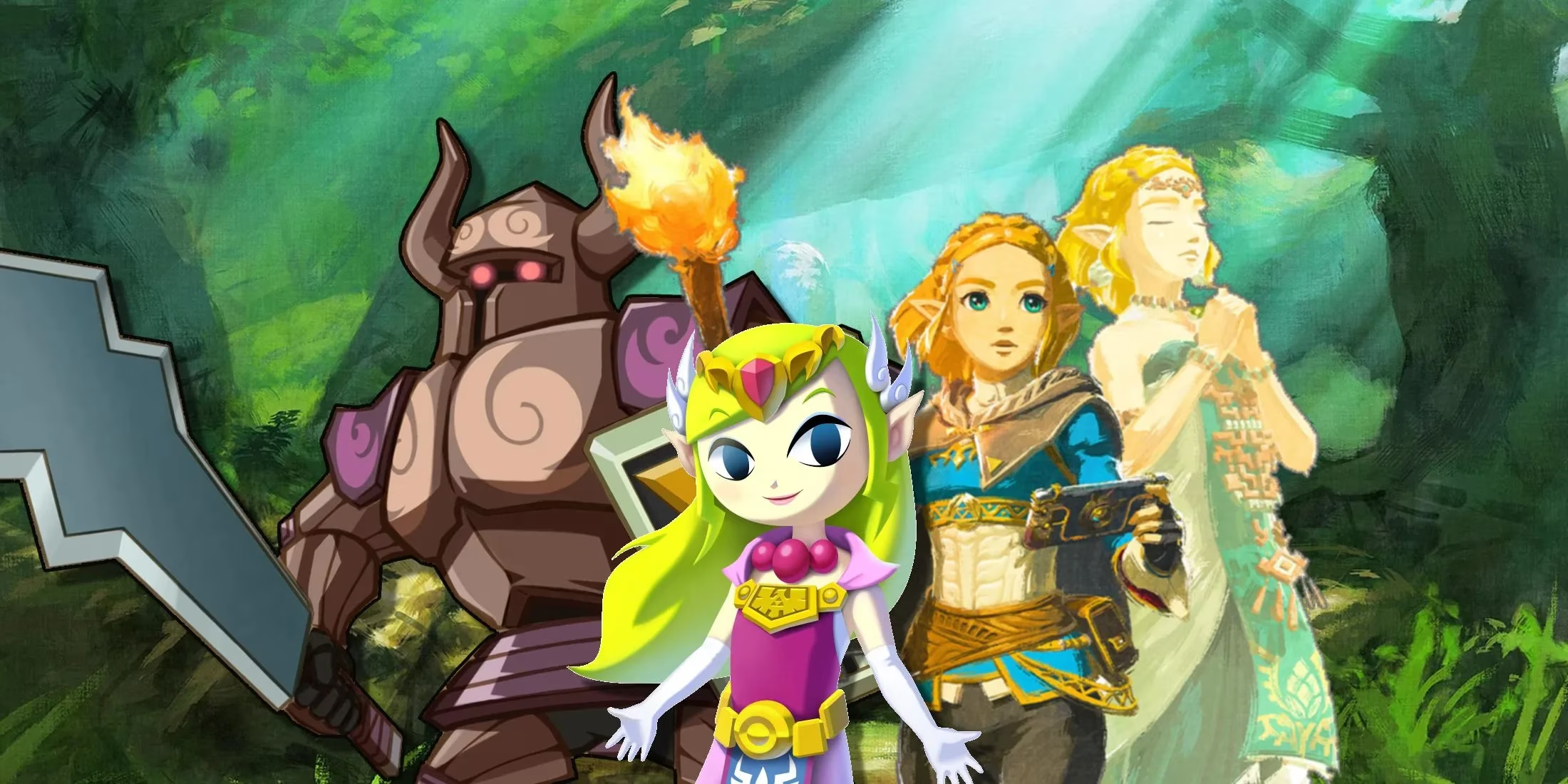
The Legend of Zelda franchise has been a cornerstone of gaming since 1986, captivating players with its rich lore, intricate timeline, and the iconic Princess who gives the series its name. 🏰 While Princess Zelda has often been relegated to a background role—a damsel in distress or a guiding voice—recent titles have begun to shift this narrative dramatically. As we look toward the future of the series in 2026, the prospect of a game where Zelda takes center stage as the playable protagonist feels more tangible than ever. The blueprint for such a title already exists, woven from two key entries: The Legend of Zelda: Spirit Tracks and The Legend of Zelda: Tears of the Kingdom. A future game starring Zelda should seamlessly merge the heroic, legendary arc of Tears of the Kingdom with the innovative, cooperative gameplay mechanics that made Spirit Tracks so unique.
The Evolution of a Princess: From Supporting Role to Legendary Heroine
The Zelda series has traditionally followed the heroic exploits of Link, the silent protagonist tasked with rescuing the kingdom and its princess. However, Zelda's role has never been static. In Tears of the Kingdom, she underwent a monumental transformation. Cast back in time, she orchestrated Ganondorf's defeat across centuries, sacrificing her very being to empower Link and the Master Sword. This wasn't a passive act of waiting; it was a proactive, universe-altering sacrifice that positioned her as the architect of Hyrule's salvation. Her story became a legend in its own right, proving she possesses the courage, wisdom, and power to carry a narrative entirely on her shoulders. This shift has ignited a passionate desire among fans to finally step into her shoes and experience a Hyrule-saving adventure from her perspective.
Spirit Tracks: The Blueprint for Playable Zelda
Long before Tears of the Kingdom, The Legend of Zelda: Spirit Tracks on the Nintendo DS offered a tantalizing glimpse of what a playable Zelda could be. In this title, set in the Adult Timeline, Zelda's body is stolen to serve as a vessel for the Demon King Malladus. Her spirit, known as Phantom Zelda, becomes Link's essential partner. Within the Tower of Spirits, the game introduced brilliant cooperative puzzle mechanics where Zelda was not just an AI companion but a crucial, player-controlled asset.
Her gameplay was distinct and complementary:
-
✨ Phantom Form: Zelda could possess armored Phantom suits, allowing her to roam areas Link could not access.
-
🧩 Puzzle Solving: She carried critical items, activated switches, and even transported Link himself across gaps and hazards.
-
🤝 True Interdependence: Progress was impossible without mastering both characters' abilities. Victory hinged on their combined efforts.
This design proved that Zelda could have a deep, engaging, and unique moveset that differs fundamentally from Link's sword-and-shield combat, focusing instead on spiritual power, puzzle mastery, and strategic support.
Why a Hybrid Approach is the Perfect Formula
A solo Zelda game shouldn't simply reskin Link's adventures. It needs a soul of its own. By combining the narrative weight of Tears of the Kingdom with the gameplay innovation of Spirit Tracks, Nintendo could create a truly groundbreaking entry.
Narrative Foundation (Tears of the Kingdom Half):
The game should place Zelda in a scenario where she is the primary actor in a grand, time-spanning legend. Imagine a story where she must use her scholarly wisdom and latent sacred power to unravel a historical mystery or confront a threat that Link cannot. The emotional depth and agency she displayed in Tears of the Kingdom must be the narrative cornerstone.
Gameplay Foundation (Spirit Tracks Half):
The core gameplay loop should evolve from the Phantom Zelda concept. Instead of just a co-op partner, Zelda's abilities could form her entire toolkit:
| Ability Type | Potential Application |
|---|---|
| Spectral Form | Phase through walls, interact with ancient spirits, and perceive hidden magical ley lines. |
| Light/Sacred Power | Combat focused on barriers, sealing magic, and purifying corruption rather than direct swordplay. |
| Puzzle Dominion | Command ancient machinery, manipulate time in localized areas, or restore broken artifacts through magic. |
| Strategic Companionship | Summon and command Phantoms or other spirits for combat support and complex environmental manipulation. |
This approach would create a fresh gameplay identity—one of a magical tactician and scholar, solving problems with wit and power where Link would use strength and agility.
The Future is Closer Than You Think
The demand for a playable Zelda is louder than ever, and there are signs Nintendo is listening. 🎮 Series producer Eiji Aonuma has publicly acknowledged the possibility of Zelda becoming a playable character in a mainline game. Furthermore, credible industry rumors in recent years have suggested that a project starring the Princess is in development. While nothing is confirmed, the stars seem to be aligning. As fans await the next big Nintendo Direct or summer presentation, the hope for an announcement of The Legend of Zelda: [Subtitle]—with Zelda's name on the box as the hero—continues to grow.
A game that honors Zelda's legacy must do more than let players control her model; it must embrace everything she represents. It needs the heart of a legend, as shown in Tears of the Kingdom, and the hands-on, inventive gameplay pioneered in Spirit Tracks. Such a title wouldn't just be a new Zelda game; it would be the culmination of decades of character development, finally allowing the Princess to forge her own legend, playable for all the world to experience. The Kingdom of Hyrule's greatest untold story is hers, and the controller should be in her hands.