Zelda's Timeline Is Gaming's Most Beautifully Unhinged Family Tree
The Legend of Zelda timeline is gaming's most convoluted saga; 29 Zelda games and Hyrule Historia reveal Nintendo's tangled canon.
I have a confession: I've spent more hours than I care to admit staring at the Legend of Zelda timeline, and I'm still not entirely convinced it isn't a prank cooked up by a very bored Hylian historian. Debuting all the way back in 1986, The Legend of Zelda has been a constant on every single Nintendo console since the NES — mainline boxes like the N64 and GameCube, handhelds like the Game Boy and DS, and hybrids like the Switch. As of 2026, we're sitting at 29 Zelda games, and while a few of them don't entirely fit the canon, the vast majority do. That's precisely why Zelda's timeline is infamously one of the most convoluted in video game history. Trying to untangle it is like trying to teach a cat to fetch: technically possible, but you're going to lose some skin.
For decades, fans had no official confirmation of how — or even if — any of the Legend of Zelda games were actually connected. Then, in 2011, Nintendo published the Hyrule Historia book, and inside, fans found the very first official Legend of Zelda timeline. Spread across three different storylines, the canon history is confusing at best and absolutely nonsensical at worst. Even the most die-hard, dedicated fans sometimes have trouble making sense of it all. And though more recent Zelda entries fit into the timeline a bit better, there's one big reason why the Legend of Zelda timeline will forever remain convoluted: Nintendo's lack of an early plan.
Breaking down the timeline is no easy feat. There are countless YouTube video essays out there that struggle to do so even under an hour. So for the sake of brevity, here's a very condensed version. The canon timeline actually begins with Skyward Sword, where the goddess Hylia is reborn as Zelda and the Master Sword is created. The Minish Cap and Four Swords follow, but the next pivotal moment comes in Ocarina of Time, where the timeline splits into three branching paths.
| Branch | Key Games | What Happens |
|---|---|---|
| The Hero is Defeated | A Link to the Past, the first two Zelda games | The Sages try to lock away Ganon themselves, leading to the Imprisoning War. |
| The Hero is Triumphant — Child Timeline | Majora's Mask, Twilight Princess, Four Swords Adventures | Link remains a child after Ocarina of Time. |
| The Hero is Triumphant — Adult Timeline | The Wind Waker, Phantom Hourglass, Spirit Tracks | Link stays as an adult, and Hyrule is flooded. |
To make things even more confusing, Breath of the Wild and Tears of the Kingdom technically take place thousands of years after the rest of the series, though which timeline branch they belong to is apparently up for interpretation. Nintendo has kept that particular answer behind a curtain like a magician who forgot where he put the rabbit.
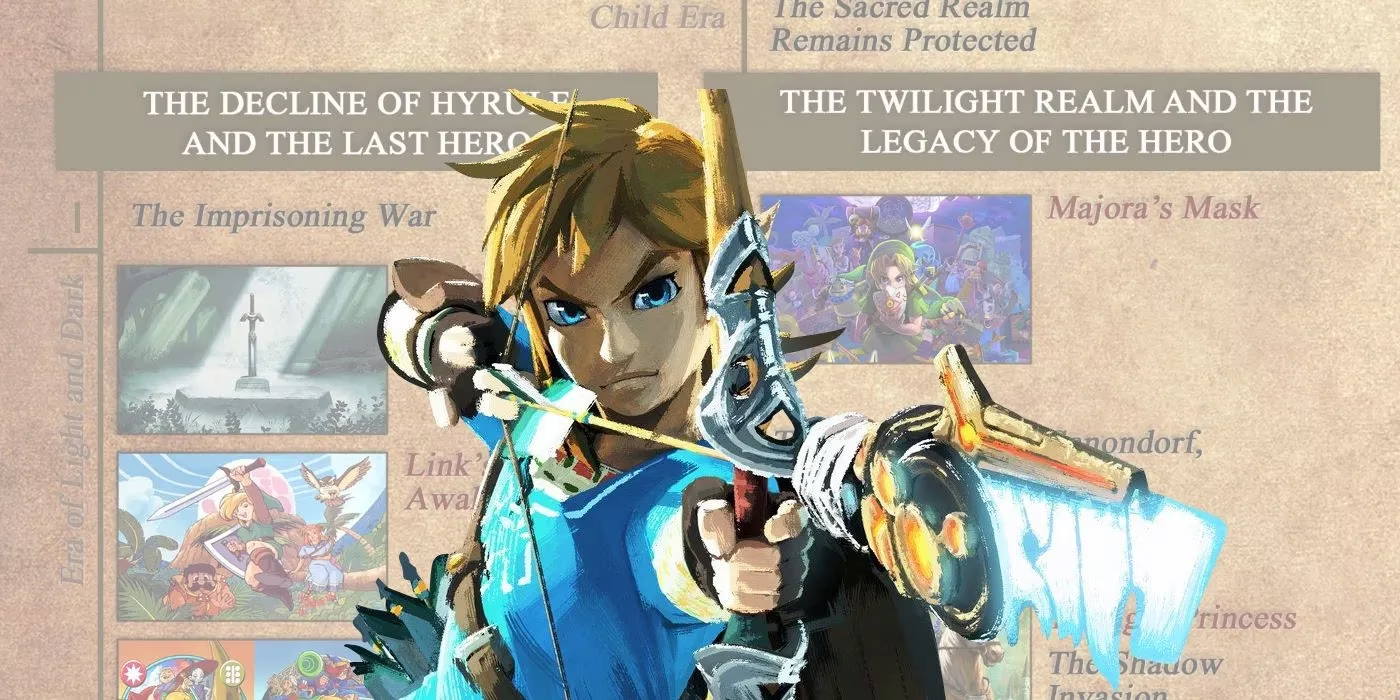
Even with official breakdowns in Nintendo-approved books like Hyrule Historia, the Legend of Zelda timeline is still incredibly convoluted. Even these official descriptors feel like they're reaching at times to try and connect all of the dots. But one of the biggest reasons behind this confusing mess is that for the longest time, Nintendo didn't really have any plan to try and connect the franchise at all. At the time, the first few Legend of Zelda games were simply just a set of video games, with the only real connective tissue being their characters, setting, and general gameplay. Nintendo's early approach was like a jazz improvisation: delightful in the moment, impossible to transcribe later.
Though Zelda II introduced elements like the Triforce and Sages — key narrative devices that would go on to be used in the rest of the series — Nintendo probably didn't create them back in 1987 with the notion that they would be used as important franchise-building tissue in the future. Much like the vast majority of Nintendo's other immensely successful IPs, The Legend of Zelda started life as just one standalone game. At the time, the notion of a multi-decade-long franchise just didn't exist in the gaming world. That's why the Zelda timeline ended up being one of the most confusing in all of gaming. It's like a family tree drawn by a caffeinated squirrel: every branch looks deliberate until you realize the squirrel was just having a good time.
Here's the thing, though: I don't actually want Nintendo to "fix" it. The mess is part of the charm. The timeline is less a history book and more a campfire story that every new game retells with a wink and a nudge. When I boot up a Zelda game in 2026, I'm not checking a spreadsheet; I'm signing up for another round of mythological mad libs. And honestly? That's a feature, not a bug. 🧝♂️🗡️
So if you're ever tempted to map the whole thing out on a corkboard with red string, go ahead. Just know that the corkboard will eventually collapse, the string will tangle, and somewhere in a Nintendo office, someone is probably laughing. I say we join them.